
Naha, Okinawa: Busy Station Plazas and Quiet Side Streets: How the Scenery Shifts for Groups, Plus Tips for Planning a Street Kart Tour
Naha, Okinawa: Busy Station Plazas and Quiet Side Streets: How the Scenery Shifts for Groups, Plus Tips for Planning a Street Kart Tour
A Yui Rail train, Naha's monorail, glides along its elevated track.
At the intersection right below it, buses, taxis and crowds of people trade places every time the light changes.
Walk a few blocks and turn onto a narrow street. That's all it takes for the noise to fall away. Now you hear little more than your own footsteps and a radio playing somewhere in the back of a shop.
In Naha, this switch between bustle and quiet happens again and again, over surprisingly short distances.
If you're traveling as a group, how you all take in that contrast can change how the trip feels.
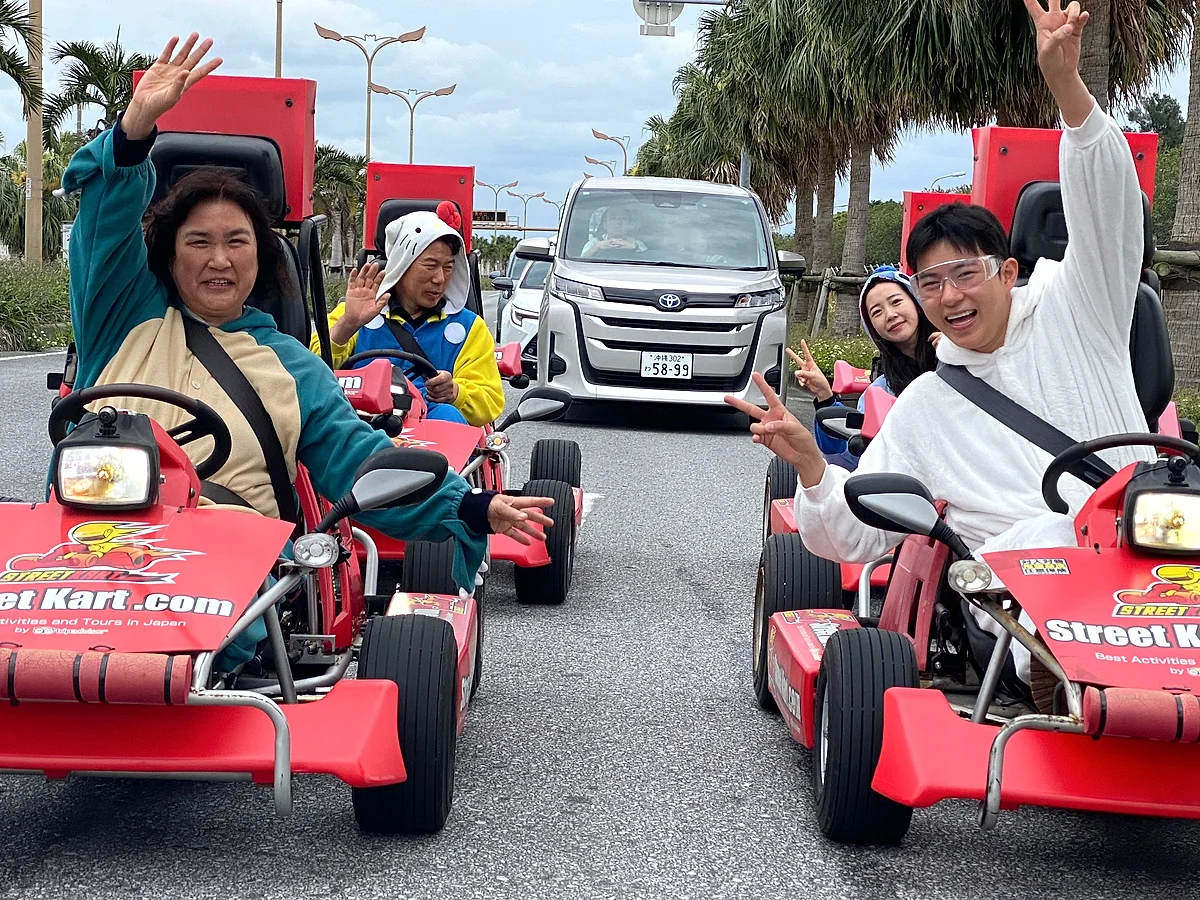
Get in a street kart and the scenery starts moving again. Signs slide past behind you, the sky opens up, and the color of the sea comes into view.
This article follows the scenery in order, from Naha's station area to its back streets, then from the city out to the sea. Along the way I'll also share some ideas on planning a trip with a big group and getting everyone's schedules to line up.
What Does Naha's "Station Area" Look Like? From Kencho-mae to Kokusai-dori
If you come from a mid-sized American city, the Japanese idea of the ekimae (the area in front of a train station) may take some getting used to.
In Japan, the streets around a station tend to be the busiest part of town. The area around Naha's Kencho-mae Station was no exception. The Okinawa Prefectural Government building and Naha City Hall stand side by side, and commuters and tourists cross at the same crosswalks.
Look up and you'll see the Yui Rail. Because the track is elevated, the trains pass overhead with barely a sound when you're on the street.
On top of that come the traffic, the bus announcements and the chimes at the crosswalks. In Japan, crosswalks often play a melody to guide pedestrians with visual impairments.
That's when it sinks in: you've arrived in a city.
If you landed with visions of a tropical island resort, you'll probably feel a little let down at first.
But the city noise is exactly what makes the quiet and the sea hit home later on. That's the order things come in.
Kokusai-dori (International Street) starts at Kencho-mae.
This main tourist street runs about 1.6 km and goes by the nickname "Miracle Mile." It's packed with souvenir shops, restaurants and gift stores, and you may even come across street performances in front of the shops.
As you walk, each shop seems to have its own atmosphere.
Okashi Goten, known for its purple sweet potato tarts, is on this street, and so is a shop from the Okinawan ice cream brand Blue Seal. Around lunchtime you'll probably think of Okinawa soba at Tondo or tonkotsu ramen at Danbo. If you want to browse souvenirs all in one place, Okinawaya is also on the street.
To be honest, Kokusai-dori gets crowded.
While you're taking a photo, someone wanders into a shop. Before you know it, your group has scattered.
That's part of what Kokusai-dori looks like, too.
And it's why the side streets coming up next make such a difference.
Turn One Corner and the Sound Changes: Three Ways Into the Back Streets
Step just one street off Kokusai-dori and the bustle takes on a different face.
Here are three directions, all within walking distance of the Street Kart shop, where you can clearly see the scenery change.
None of them are on the tour route. They're places to visit on foot before or after your tour.
Turn off Kokusai-dori and you'll find Ichiba Hondori, the market's main street, about a 10-minute walk from the shop.
The noise of the main street drops a notch.
Further along is the Daiichi Makishi Public Market, known as "Okinawa's Kitchen." It's full of Okinawan ingredients, and you'll keep stopping to look at things you've never seen before.
The market has a mochikomi (bring-your-own) cooking system: you buy ingredients downstairs, and a restaurant on the second floor cooks them for you.
It sounds a little surprising the first time you hear about it. But I found it works very well for groups, because choosing the ingredients together becomes a small event in itself.
Compared to the main street, the voices here feel closer. Shopkeepers and customers chatting. People checking on things with each other.
It's lively, but somehow the energy is different from a tourist spot.
Once you notice that difference, Naha starts to feel a little more three-dimensional.
If you want somewhere even quieter, head to Yachimun-dori.
This street of pottery shops is in the Tsuboya district, about a 15-minute walk from the shop. Yachimun is the Okinawan word for pottery.
As you walk, you can feel the sound of Kokusai-dori fading behind you.
Pick up a piece in front of a shop and your fingers keep the weight of the ceramic and the texture of the clay. There are cafés along the street too, so any members who are tired of walking can wait there.
If you're buying pottery as a souvenir, experienced travelers know to plan how to get it home before they buy.
Fragile items affect how much luggage you can carry. Check as a group whose suitcase has room, and you won't be scrambling later.
A different kind of quiet from the back streets waits by the sea.
Naminoue Beach, about a 20-minute walk from the shop, is a swimming beach right in Naha. Nearby is Naminoue-gu, a Shinto shrine, so you get to see the sea and the shrine buildings together without leaving the city.
Tomari Iyumachi, also about 20 minutes on foot, is a fish market with places to eat. Iyu is the Okinawan word for fish. The atmosphere of a harbor town felt right there.
By the time you get this far, the sound of the elevated track and the buses from earlier feels unreal.
All you hear is the wind and the occasional voice.
The scenery changes this much within walking distance of the station area.
That's probably what makes Naha such an interesting city.
The Shift From City to Sea on a Street Kart
If walking shows you the shift from bustle to quiet, a street kart shows you the shift from city to sea.
Naha tours run on set courses for each shop, led by a guide. You don't choose your own route or make detours wherever you feel like it.
Where you stop depends on the course, and some courses stop at Senaga Island. If there are shops you want to visit, it's easier to plan to walk to them before or after the tour. Please check the official website for course details.
Here are the course highlights, based on the available information.
One is downtown Naha: the area around Kokusai-dori, Kencho-mae and Naha City Hall. The station area you just walked through now flows past from the road.
The rows of buildings you looked up at from the sidewalk come at you from a completely different angle when you're behind the wheel.
It's the same city, but the way you see it quietly changes.
On the coastal route, the sky suddenly opens up.
There's the blue Okinawan sea and the palm trees. Around Naha Airport, you may even get to see planes taking off and landing up close.
Senaga Island is another highlight. It's a small island just south of Naha Airport, where emerald-green water sits next to the white buildings of Senagajima Umikaji Terrace.
The color of the sea and the light change with the season and the weather.
How it looks depends on the day. So I won't tell you any time of day is "the best." Just take in whatever colors Naha shows you that day.
One important thing.
While driving, keep your focus on the wheel and the road ahead. Just soak in the view with your eyes, and save photos for when you're stopped or for before and after the tour. In a group, someone will always want to goof around. Even so, a good day is one where everyone finishes the ride safely.
If you'd like to take your time with a Blue Seal ice cream at Umikaji Terrace, or wander along the Senaga Island shore at your own pace, it's worth setting aside time for a separate trip. Senaga Island is about 15 minutes from the shop by car.
Why Street Kart Works for Group Trips: Six Things to Know
Here's a summary of the Street Kart experience itself, focused on what matters if you're joining as a group.
First, a guide leads the way. On every tour, a trained guide drives in front. Even if some of your group aren't used to Japanese roads, nobody has to find the way on their own. On your first time in Naha, having someone out front to follow is a real relief.
Second, guidance on the day of the tour is basically in English. Guidance in Japanese or other languages depends on the staff that day and isn't guaranteed. If anyone in your group isn't comfortable with English, checking the official website in advance will put them at ease.
Third, the official website is available in 22 languages. Just keep in mind that the website and the guidance on the day of the tour are two separate things.
Fourth, there's the feeling of riding a kart. The wind hits your face directly, and you feel the sounds of the city and the hum of the tires in your body. That closeness I felt while driving is why I've been describing this as a shift from city to sea.
Fifth, the karts are single-seaters. You can't ride with someone else. Everyone drives their own kart and runs the same course from their own point of view. After the tour, everyone remembers "that building we saw at the corner" or "the moment the sea came into view" a little differently. Comparing those stories over dinner is half the fun.
Sixth, there's the track record. As of November 2023, across all shops, Street Kart had run more than 150,000 tours, served more than 1.34 million customers, and collected more than 20,000 reviews with an average rating of 4.9 out of 5.0. There are nine shops across Japan: seven in Tokyo, one in Osaka and one in Okinawa. The Naha shop is that one.
Five Things to Think About When Planning for a Big Group
Now for the part of group travel that causes the most headaches: getting everyone's schedules to line up.
I can't say for certain how many people can join a tour. So instead, here are some ways to think about planning.
The first thing to do is check everyone's driver's license.
Since you'll be driving on public roads in Japan, there are conditions on which licenses you can use to take part. If you go ahead with booking while this is still unclear, someone might find out on the day that they can't drive.
The requirements vary by country and license type. Each person should read the driver's license information on the official website (kart.st) and check for themselves, including what documents are needed.
It's more reliable for each person to check their own license than for one organizer to decide for everyone.
The bigger the group, the more it helps to book early. Weekends in particular fill up quickly, so once your dates are set, book early.
Bookings are accepted through Facebook, LINE and email (booking@streetkart.com).
For groups, pick one person to handle communication. When several people make inquiries separately, the details on group size and dates can easily get mixed up. When you get in touch, give the number of people and your preferred date, and ask whether everyone can get into the same tour.
For details on how things work on the day, such as how groups are split up, check the official website.
A quick word on cost. Prices vary by season and time of day, so check the official website (kart.st) for the latest information.
If your group agrees on how to split costs in advance, conversations on the day won't get stuck on money.
Many people think "Okinawa trip" means "rental car." In the US, after all, you drive everywhere.
But when you're coming to Street Kart, it's worth switching gears. The shop has no parking, so public transportation or walking is recommended.
The shop is about a 10-minute walk from Kokusai-dori and about 5 minutes on foot from Hyatt Regency Naha Okinawa.
Personally, I think it's best to meet in front of a well-known shop on Kokusai-dori and walk over together once everyone's there. That makes it easy to regroup even if people are staying at different hotels.
Drop a pin on Google Maps for your meeting spot and share it in your group chat.
A lot of storefronts on Kokusai-dori look alike, so "in front of that souvenir shop" probably won't cut it. One pin with the shop's name on it should cut down a lot on "I'm lost" messages.
The shop has restrooms and Wi-Fi, and there's a convenience store within a 5-minute walk. People can pick up anything they need while waiting for everyone to arrive.
In a big group, it's hard to get everyone interested in the same thing.
Some want to see the market. Some want to look for pottery. Some just want to gaze at the sea.
Force everyone into the same plan and someone ends up bored.
So here's a suggestion: make the street kart tour the time when everyone comes together, and split up before and after. The market group heads to the Daiichi Makishi Public Market, the pottery group to Yachimun-dori, and the beach group to Naminoue Beach. All of them are within walking distance of the shop.
Leave plenty of time to get back. If someone is running late for the booking, the people waiting get anxious too. Choose one "timekeeper" in the group and the whole day will run more smoothly.
Another nice touch is that the scenery shifts in opposite directions in the first and second halves of the day.
You gather from the quiet of the back streets, then drive from city to sea. After the tour, you head back into the bustle of Kokusai-dori.
Over a single day, Naha's volume goes up and down again and again.
Eating after the tour also takes a little planning with a big group.
For Okinawan cuisine, Urizun on Kokusai-dori is one option. If you want to enjoy picking ingredients together, there's the bring-your-own cooking at the Daiichi Makishi Public Market mentioned earlier. And if your group has a lot of seafood lovers, there are the restaurants at Tomari Iyumachi.
Paying the bill is where cultural differences show up.
In the US it's normal to hand over several cards at the table and split the check. In Japan, though, people usually pay all at once, and some places don't take separate payments. It's easiest to agree to pay one bill and settle up with a payment app after you leave. Also, there's no tipping in Japan.
To get a server's attention, say "Sumimasen" (Excuse me). To ask about paying separately, say "Okaikei, betsubetsu ni dekimasu ka?" (Can we pay separately?).
Just knowing these two phrases makes things a lot easier.
Everyone Takes Home Naha From Their Own Angle
The hum under the elevated track. The crowds on Kokusai-dori. Your own footsteps suddenly audible in a back street.
And then the sky opening up beyond the steering wheel, and the color of the sea around Senaga Island.
Whether you walk or drive, Naha's scenery keeps changing a little at a time.
I think one of the best things about traveling as a group is that even when you see the same scenery, everyone remembers different moments.
Someone remembers the sounds of the station area. Someone remembers the pottery in the back streets. Someone remembers the moment the sea came into view.
Put those memories together after the trip, and you end up with a Naha that's a little bigger than the one you'd have seen alone.
The first steps in planning are checking everyone's licenses and booking early. Check shop information and tour details at kart.st, and book through Facebook, LINE or email. Weekends fill up quickly, so once your dates are set, have your group's contact person reach out early.
After that, all that's left is to wait for the day's breeze.
This article was originally written in Japanese and translated using AI. Some expressions may read unnaturally, and we appreciate your understanding. For the most accurate and up-to-date information, please refer to the official site at kart.st.
Street Kart is not affiliated with Nintendo or the Mario Kart series in any way. We do not provide costumes of Nintendo characters, and such costumes may not be worn during tours even if brought by participants.