
Planning a Group Day in Okinawa as Autumn Days Get Shorter: A Step-by-Step Approach Built Around a Street Kart Tour
Planning a Group Day in Okinawa as Autumn Days Get Shorter: A Step-by-Step Approach Built Around a Street Kart Tour
After September, the sky over Naha gets dark a little earlier each day.
You don't really see it happening. You notice it on something like the last day of your trip, when the whole group still hasn't gathered and the sea is already dark.
Four people, six, eight. The bigger the group, the more often you end up saying "wait, it's already dark?"
I wrote this article for people visiting Okinawa as a group for the first time in autumn. It's about how to plan a day when daylight is short, using a street kart tour you can join in Naha as the anchor. We'll go through it step by step.
First, Some Background: How the Seasons Change in Autumn Okinawa
By the time news of autumn leaves arrives from mainland Japan, Okinawa is changing seasons in its own way. The trees don't turn color. Instead, the color of the sea and the angle of the sunlight tell you the season is shifting.
September can still have days with lingering summer heat. Through October and November, the air slowly starts to feel different. That slow change is easy to miss when you're planning a trip.
If you're traveling with friends from abroad, they may be used to Daylight Saving Time, where evenings suddenly get dark from one day to the next. Japan doesn't use Daylight Saving Time, so there's no obvious cue like that. From September through November, sunset just keeps coming a little earlier, without anyone pointing it out.
"It was still light out in that travel blog from last week." That may no longer be true on the dates you're traveling.
The first step is very simple. Once your travel dates are set, look up the sunset time in Naha for those days in a weather app or on Google, then post it in your group chat.
I won't give specific times here, since they change with the date. What matters is that everyone plans from the same number.
In a large group, "while it's still light" often means a different time to each person. Sharing one number up front heads off a lot of confusion later.
Step 1: Schedule the Fixed Plans First
For group trips, it helps to lock in the plans that can't move first, then arrange everything else around them.
Street Kart runs guided tours, so you'll be moving according to the date and time you booked. That makes the tour the anchor of your day. Everything else goes before or after it.
Departure slots, time windows, tour length, pricing, how many people can be accommodated, and where the tour stops along the way all vary by location, plan, and season, so I can't list them here. Prices depend on the season and time of day. For all of these details, including the latest information, check the Street Kart official website (kart.st).
Once you know the start time, you'll get a rough sense of how the sky might change while you're driving.
Do you want to drive with the sea bright beside you? Or do you want to drive while the sky is changing color?
Neither one is the right answer. People in the group will have different preferences about the light. Talk about it first, and choosing a slot gets easy. That conversation is probably the key to the whole plan.
One more thing: weekends tend to book up quickly. The larger your group, the more you'll worry about whether everyone can get into the same tour. If your preferred dates include a weekend, it's a good idea to book early.
I can't tell you here exactly how many people can be accommodated. Before booking, send them your group size and preferred dates as they are, and confirm.
Before Booking, Make Sure Everyone Meets the Driving Requirements
This sometimes happens when traveling with friends from abroad: one person in the group hasn't prepared the driver's license documents they need.
Street Karts are vehicles that drive on public roads, so there are driving requirements. On every tour, a trained guide drives in front, handling the route and watching out for everyone's safety. Even if someone in your group has never driven on Japanese roads, they'll follow the guide along the route. The requirements are laid out on the official driver's license page. Send that link to everyone in the group before you get in touch to book.
The key is that the organizer shouldn't carry all of this alone. Ask everyone: "Read this page to see what you need for your own license, and reply once you've read it." That way everyone can see where each person stands.
This matters even more if your group includes several nationalities. Requirements may differ by country. Don't assume one person's situation applies to everyone.
If you don't have your original license with you on the day, you can't join the tour and won't get a refund. Leaving it in the hotel room is enough to keep one person off the road. Even a quick "Everyone have your original license?" in the chat on the morning of the tour makes a difference.
You'll also want to plan for members who won't be driving. Karts are single-seaters, so no passengers are allowed. If someone can't get their license documents ready in time, or just doesn't want to drive, decide in advance where they'll spend the tour: waiting on Kokusai Street, resting at the hotel. With one set place, meeting up after the tour is easy.
Step 2: Decide How to Use the Daylight Hours
With the anchor set, the next question is how to use the daylight.
When days are short, the basic rule is to get the things that need daylight done in the morning or around midday.
There are several places near the Naha location that you can visit before or after the tour. These are just places near the shop. They are not on the kart route.
Take Yachimun Street (Tsuboya), for example. It's about a 15-minute walk from the shop. It's lined with pottery shops, where you can find dishes and cups made in Okinawa's traditional pottery style, yachimun.
When a group walks around here, people naturally split up. Some pick up pottery. Some take photos. Some want to sit down in a café.
I think that's fine. As long as you set a time and place to meet, nobody has to do the same thing.
If you want to see the ocean, Naminoue Beach is about a 20-minute walk from the shop. Naminoue Shrine is right next to it.
You could spend the morning at the beach, shower and change, and then head to the tour. That way you leave with both the sea in full daylight and the views from the tour.
Some people may want to go out to Shuri Castle. It's about 20 minutes by car from the shop. Shuri Castle is still being rebuilt after the 2019 fire. Personally, I think seeing it partway through that rebuilding is worthwhile in itself.
Groups take longer to move around, though. Splitting into several taxis, waiting for everyone to arrive: that alone uses up more time than you'd expect.
When days are short, it's safer to visit the farthest places earliest in the day.
Also note that the shop has no parking. Public transportation is recommended. Even if your group is traveling by rental car, plan to take public transportation or a taxi on the day of the tour.
If you're booking the tour on the last day of your trip, plan for your luggage too. The shop has lockers for small items, but they aren't suitable for large luggage like suitcases. The karts are only meant to carry a smallish bag. For large luggage after checkout, decide before the tour where it will go, for example by leaving it with your hotel. The bigger the group, the more suitcases there are.
Hyatt Regency Naha Okinawa is about a 5-minute walk from the shop. For a large group, it can be a handy landmark to meet at.
Step 3: Think About the Tour Scenery Together with the Light
On the Okinawa location's tours, you'll see Senagajima Island, the area around Naha Airport, the area around Kokusai Street, coastal roads, and more.
Senagajima is a small island south of Naha Airport. It has Senagajima Umikaji Terrace, a row of white buildings, and emerald-green water.
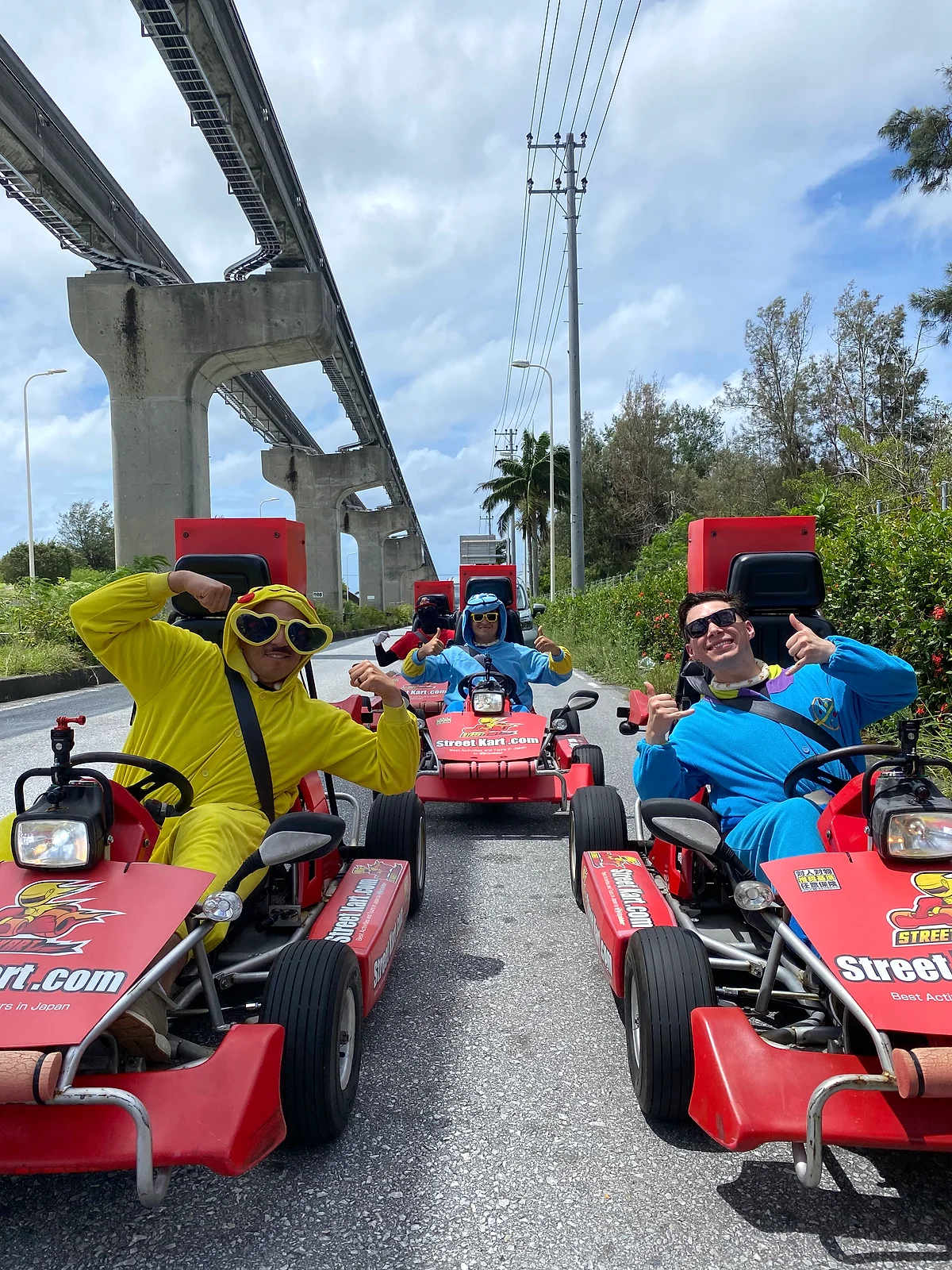
The karts are single-seaters. You put on goggles and the rest of the gear, take the wheel yourself, and drive on public roads with your eyes close to the ground. The guide is right in front of you. You stop at traffic lights, follow Japanese traffic rules, and stay behind the guide. On the coastal roads, the sea breeze hits you head-on. The karts have no suspension, so you feel every bump in the road. Near the airport, planes taking off and landing appear right in your line of sight as you drive.
Driving past Senagajima while it's bright enough to see the sea's color clearly, or while the sky turns from orange to navy, will probably feel like two completely different experiences.
In autumn, sunset gets a little earlier day by day. Even in the same time slot, the light in September and November may differ.
Plan your clothing around your time slot too. Closed-toe shoes (sneakers are recommended) and clothes that are easy to move in are the basics. Participants are asked to avoid open-toed shoes such as sandals, heels, and skirts or dresses. The list of things to bring also includes a jacket suited to the season. If you pick a later slot, a message in the chat reminding everyone to bring a layer is a good idea.
Talk about the weather as a group ahead of time, too. In light to moderate rain, tours go ahead as planned and free raincoats are provided. Tours are canceled in heavy rain or typhoons. In that case, you choose between a shortened tour (with the difference refunded), rescheduling, or a full refund. Deciding by the day before which option you'd take if the tour is canceled saves you from scrambling on the day, rather than leaving one person to decide on the spot. Check the official website for the latest terms.
One thing to keep in mind: the tour follows a set route led by a guide. Where you stop along the way and how you spend that time depends on the course.
If you want to take your time shopping at Senagajima Umikaji Terrace, or sit and enjoy a Blue Seal ice cream, set that aside as a separate block of time before or after the tour.
On your itinerary, list "places we pass on the kart" and "places we'll visit on our own" separately. That alone heads off small misunderstandings within the group.
Step 4: Plan the After-Dark Hours from the Start
When daylight is short, one thing is easy to overlook: the time after dark.
In summer, you can decide on the spot: "It's still light, let's stay out a bit longer." In autumn, that doesn't work. It may already be dark when the tour ends.
Decide your after-dark plans from the start, and the group's evening will flow on its own.
In Naha, Kokusai Street is a good candidate for the evening. It's a street about 1.6 km long, lined with souvenir shops and restaurants, known as the "Miracle Mile." It's about a 10-minute walk from the shop. If you missed out on Blue Seal ice cream at Senagajima, there's a Blue Seal shop on Kokusai Street too.
Makishi Public Market is near Kokusai Street. You can pick out Okinawan ingredients at the market and have them cooked for you on the second floor.
For a big group sharing a table, I think this is a lot of fun. Passing plates around and asking each other "What's this?" Moments like that often end up at the heart of your memories of the trip.
I have one more suggestion. After the tour, the whole group doesn't have to head straight to the same place. Split into smaller groups for a while, then meet up later at a set place.
Anyone who's tired can rest at the hotel for a bit. Anyone who wants to look at souvenirs can walk Kokusai Street.
Just decide on a meeting place and time for after dark. Even with a large group, that makes for an easy evening.
The Steps to Booking, and a Final Tip Before You Go
Finally, here's a recap of the plan as a path to booking.
First, look up the sunset time for your travel dates and share it with the group. Next, have everyone check the official page to confirm they meet the driving requirements. Then put together your group size and preferred dates and get in touch about booking.
Bookings are accepted via Facebook, LINE, and email. Guidance on the day of the tour is generally in English. Japanese or other languages depend on the staff working that day and are not guaranteed. The website is available in 22 languages. That's just the website; it's separate from the guidance on tour day.
On the day, there's a check-in and safety briefing before departure. The bigger the group, the longer it takes for everyone to gather. Confirm how early to arrive from the instructions you get when booking, and set the group's meeting time a little earlier than that.
Once your tour time is set, place your daylight plans and after-dark plans before and after it.
Yachimun Street and Naminoue Beach while it's light. Kokusai Street and Makishi Public Market as meeting spots after sundown.
Just arranging things this way makes an autumn day in Okinawa come together easily.
A trip during the short-day season might feel like you're missing out. But it's also a season when the parts of the day are clearly divided.
What to do while it's light. What you want to see as the sky changes color. Where everyone meets up after dark.
Talk this through just once before you leave. Then, on the flight home, you might all remember the same color of the sky.
Start by checking the Okinawa location's tours on the official website and pasting the link in your group chat.
This article was originally written in Japanese and translated using AI. Some expressions may read unnaturally, and we appreciate your understanding. For the most accurate and up-to-date information, please refer to the official site at kart.st.
Street Kart is not affiliated with Nintendo or the Mario Kart series in any way. We do not provide costumes of Nintendo characters, and such costumes may not be worn during tours even if brought by participants.