
Seasonal Clothing for Riding Okinawa as a Group: How to Plan Ahead So Fewer People Say "I'm Cold" or "I'm Hot"
Seasonal Clothing for Riding Okinawa as a Group: How to Plan Ahead So Fewer People Say "I'm Cold" or "I'm Hot"
"Hey, why didn't anyone tell me to bring a jacket?"
Picture someone in your group saying that right before your street kart ride in Okinawa.
The clothing plan for that day went a little wrong.
The bigger the group, the more a clothing mistake spreads beyond one person. When someone is hunched over and shivering, or their arms are turning red in the sun, everyone else notices. Nobody says anything, but the mood slowly gets heavier.
This article won't focus on temperature numbers. It uses the faces of the people you're traveling with as the guide. We'll go step by step through how to decide what to wear each season and how to get the message to everyone.
Clothing mistakes show up first on your companions' faces
Imagine a group of six.
One person handles heat well. Another says "samui" (cold) the moment they step into an air-conditioned shop. Someone else wants to pack light and shows up with nothing to put over their shirt.
Everyone can check the same weather forecast and still show up dressed completely differently.
With group travel, the goal isn't to find the one "right outfit." It's to think ahead about who is most likely to complain first.
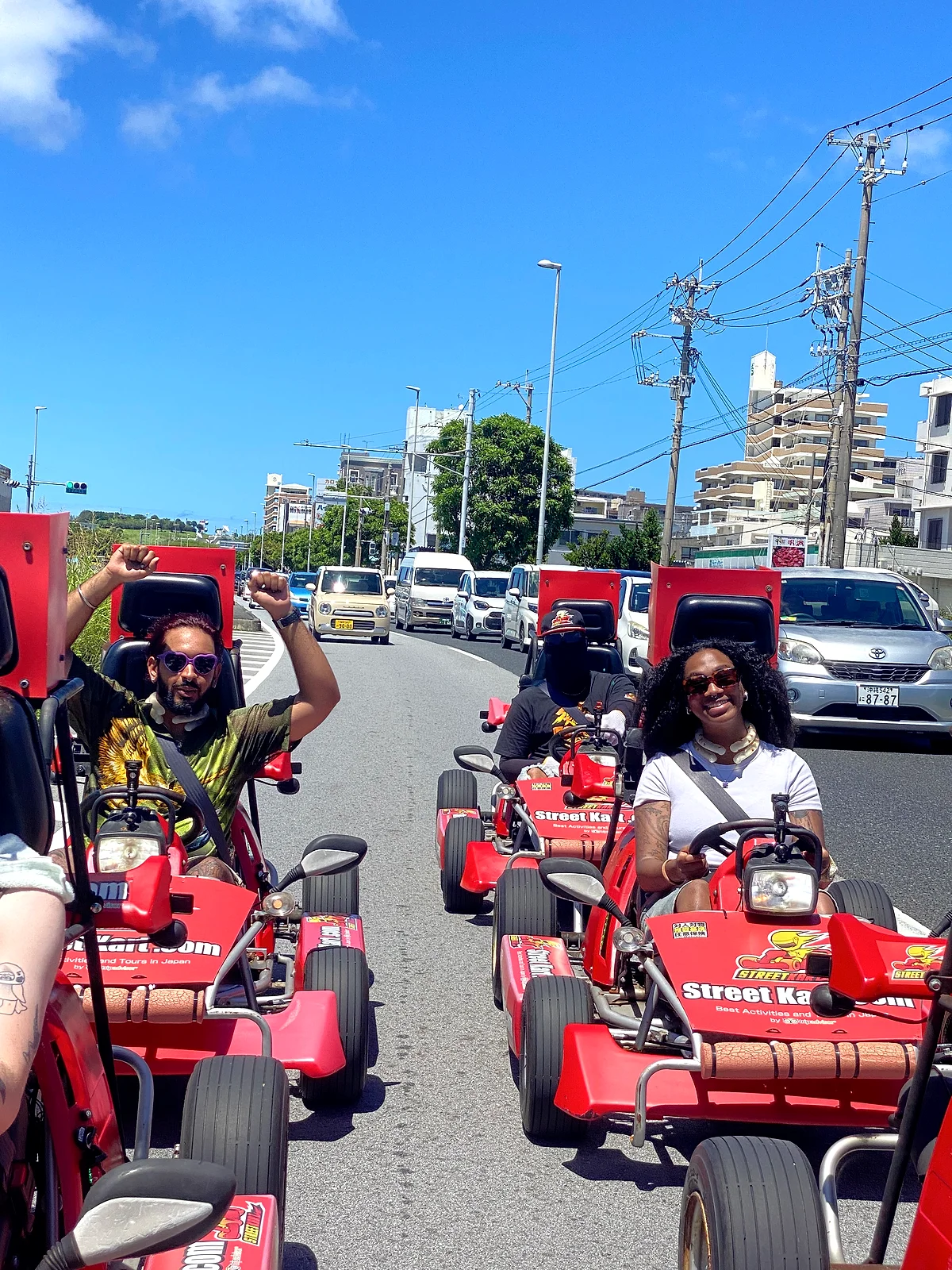
The karts have no roof. The seat sits close to the road. Sun and wind reach you with nothing in the way.
You hear the city and smell the ocean directly. That's what makes these vehicles fun. But if people aren't dressed for it, the same conditions turn straight into "I'm hot" and "I'm cold."
So the approach can be simple.
Plan around the person in your group who gets cold most easily and the person most worried about sunburn. If those two are comfortable in what they wear, the rest of the group probably won't be far off.
That's a much faster decision than polling everyone on what they like.
There's also a baseline that applies to everyone, whatever the season. The official guidelines recommend clothes that are easy to move in, like jeans or casual wear, and say to avoid skirts, dresses, and expensive clothing.
Someone in the group may have packed their favorite dress or a brand-new coat for travel photos. Ask them to save it for dinner after the tour. If the whole group agrees on this baseline before you talk about seasonal clothing, the rest of the conversation goes much faster.
Summer in Okinawa: Avoiding "My arms are stinging"
In summer, the word you're likely to hear from your companions may be "it hurts" more than "it's hot."
When you're in strong sun for a long time, your skin starts to burn.
Someone comes straight from the beach in a tank top. Late in the tour, that person is quietly rubbing their arms. It's easy to picture.
In summer, I'd suggest thinking "clothes that protect your skin" instead of "clothes that keep you cool." That leads to fewer complaints later.
A thin long-sleeved shirt, or a breathable rash-guard-style light cover-up. Having just one layer changes how the sun hits you.
For sunscreen, agree on a time for everyone to reapply before departure. That way, it's less likely someone forgets.
The official guidelines also recommend hats and sunglasses in summer. Besides sunscreen, they list water bottles and drinks as handy items to bring.
On a hot day, by the time one person says "I'm thirsty," everyone else usually is too. If you decide in advance that each person brings one drink, it's less likely someone will have to dash to a convenience store right before departure.
There's one trap that groups in particular fall into here.
It happens when you put the beach and street karting on the same day.
Naminoue Beach is about a 20-minute walk from the Naha store. That's close enough that you'll want to swim first and then head over.
But if people arrive wearing clothes over wet swimsuits, neither they nor the people waiting next to them will feel comfortable. If you include the beach, write time for showering and changing clearly into the schedule.
If one person takes too long to change, the whole group is late to check in.
For shoes, the official guidelines recommend closed-toe shoes (sneakers) and say to avoid open-toe shoes and heels. Some items, like hats, may leave you unsure how to handle them while driving.
The most reliable approach is to check the dress rules on the official website beforehand and paste them into your group chat.
The most awkward situation is when someone who assumed "it'll probably be fine" runs into trouble on site.
Summer into fall is also typhoon season. Check the official guidelines before departure for how tours are handled in bad weather.
Winter in Okinawa: Why "it's cold even in the tropics" happens
In winter, what you're likely to hear is surprise.
"Wait, Okinawa gets this cold?"
If people pack based only on the image of a southern island, some will show up in T-shirts and shorts.
Winter in Okinawa has windy days. Even if it's warm in the sun, constant wind slowly cools your body down.
Some of Street Kart's Okinawa store courses pass around Senaga Island, Naha Airport, and along coastal roads. The emerald-green sea is beautiful. But those are also places that take the ocean wind head-on.
For winter, it all comes down to "being able to adjust with layers."
Rather than one heavy coat, put a windproof layer like a windbreaker over a long-sleeved shirt. That makes it easier to regulate your body temperature.
For the bottom layer, a long-sleeved shirt that won't leave you chilled if you sweat is a safe choice.
If you walk around Kokusai Street before the tour, you may be a little sweaty by the time you reach the store. Then, when the sea breeze hits you, the sweat cools and you're likely to feel colder than it actually is. Not packing too much into the pre-tour schedule is also part of your winter clothing plan.
The Japanese word "haori" (a layer you put on top) is commonly used. It might come in handy if you need to buy extra clothing locally.
You can probably picture someone who thought "it's Okinawa, I don't need a jacket" searching the shops on Kokusai Street for a hoodie after the tour.
Kokusai Street is about a 10-minute walk from the store, so buying something extra is possible.
But if you don't realize it before the tour, it doesn't help.
Once you've decided to plan around the member who gets cold easily, don't brush off what they say as "exaggerating."
Everyone feels cold differently. The person themselves knows best.
Spring, fall, and the rainy season: When opinions split the most
Spring and fall are the seasons when a group is most likely to disagree about clothes.
On the same day, one person says "short sleeves are plenty" and another says "long sleeves, just in case."
Neither is wrong. That's what makes it a little tricky.
During these seasons, it works better not to make everyone dress the same.
The only thing to decide is a minimum agreement: "Everyone brings one extra layer." Whether to wear it is up to each person.
If you're hot, take it off. If you're cold, put it on.
The only thing to avoid is someone not having one. That's enough.
A quick word on the rainy season too.
The rainy season in Okinawa starts earlier than on Japan's main islands. It can be sunny one moment and suddenly pouring the next.
Street Kart provides raincoats on rainy days. However, how tours are handled on rainy days depends on the weather, so check the official guidelines.
According to the official guidelines, tours go ahead as scheduled in light to moderate rain and are canceled in heavy rain or typhoons. That means you should plan your clothing assuming you'll ride in light rain.
Some members may think, "It's raining, so sandals." But closed-toe shoes are recommended on rainy days too. Just tucking a spare pair of socks in your bag will make your feet much more comfortable after the tour.
What groups should watch out for is what they wear under the raincoat.
If you choose quick-drying fabrics, you won't have to walk around in wet clothes when you move on to Kokusai Street or Makishi Public Market after the tour.
"Staying wet until the next stop."
That quietly dampens your companions' mood.
Clothing logistics for larger groups
Now for the part of group travel that takes the most effort.
Getting the word to everyone, and getting everyone to follow it.
The first thing to share is that each kart is a single-seater. No passengers are allowed.
Since everyone drives their own kart, every member needs a driver's license.
Which licenses are accepted, and what to bring on the day: have each person check the license information page (About Driver's Licenses). If you paste this link into the group chat along with the clothing info, it's less likely someone will miss it.
If you don't have the required documents on the day, you can't take part.
No matter how well you're dressed, that's where it ends. Please keep that in mind.
Next, choose one person to be in charge of clothing.
In a large group, everyone assumes someone else will mention it, and the day arrives with nobody having said anything.
The clothing coordinator only needs to read the official dress guidelines and send one seasonal line to the chat.
For winter, for example: "Everyone, bring one windproof layer. Don't come in just short sleeves."
For summer: "Everyone, bring a thin long-sleeved shirt or cover-up. Bring your own sunscreen and drink. No sandals."
Whatever the season, add two more: "Avoid skirts and dresses" and "Don't bring large bags."
Luggage gets overlooked as often as clothing does. The official guidelines say a smallish bag is best for the kart, and the store's lockers are for small items, not large luggage like suitcases. If you're traveling and touring on the same day, decide together with the clothing plan that everyone drops their luggage at the hotel before meeting up.
That alone cuts down on "nobody told me" on the day.
You'll also want to plan the meetup together with clothing.
The store has no parking, and public transportation is recommended. If traffic is heavy, you could be late for your reservation.
If some members need to change or buy something, move the meeting time earlier to allow for it.
There's a convenience store within a 5-minute walk of the store. If someone forgets sunscreen or a drink, there's a chance they can buy it before departure.
Finally, things get easier if you plan your pre- and post-tour schedule around your clothes.
If you add something after the tour in winter, stroll Yachimun Street (a street lined with pottery shops), about a 15-minute walk away. Pick out souvenirs on Kokusai Street. You can take your time in just your extra layer.
If you go to the beach first in summer, step into the shops on Kokusai Street after the tour to get out of the sun for a while.
Don't think about clothing and the schedule separately.
That, I think, is a small trick for keeping everyone in a good mood on a big group trip.
What makes Street Kart great
Now that your clothing is sorted, here's a little about riding Street Kart in Okinawa.
Tours are led by a guide. On every tour, a trained guide drives at the front.
For the organizer who's usually leading the way with a map in hand, having someone's back to follow up front might take a bit of weight off their shoulders.
A note about language as well. On the day, the tour is basically conducted in English. Guidance in Japanese or other languages depends on the staff that day and is not guaranteed.
Just add one line to the group chat before you go
Clothing mistakes come less from the weather and more from "what nobody said."
In summer, one layer to protect your skin.
In winter, one windproof layer.
In spring and fall, make sure everyone has an extra layer.
That's about all you need to decide.
After that, the clothing coordinator sends one line, pastes the license info link, and leaves a little extra time before the meeting time.
Then, after the tour, what you hear might not be "I was cold," but talk about the color of the sea or the plane that crossed overhead.
Weekends tend to book up, so once your dates are set, try to move early. For details on things that change by season, such as clothing, what to bring, and weather policies, check the official website. For reservations or group size questions, you can contact them via Facebook, LINE, or email (booking@streetkart.com).
On the morning you head out, someone has a folded jacket in their bag.
That alone changes how the wind feels, just a little.
This article was originally written in Japanese and translated using AI. Some expressions may read unnaturally, and we appreciate your understanding. For the most accurate and up-to-date information, please refer to the official site at kart.st.
Street Kart is not affiliated with Nintendo or the Mario Kart series in any way. We do not provide costumes of Nintendo characters, and such costumes may not be worn during tours even if brought by participants.